ABOUT THE POSTCARD
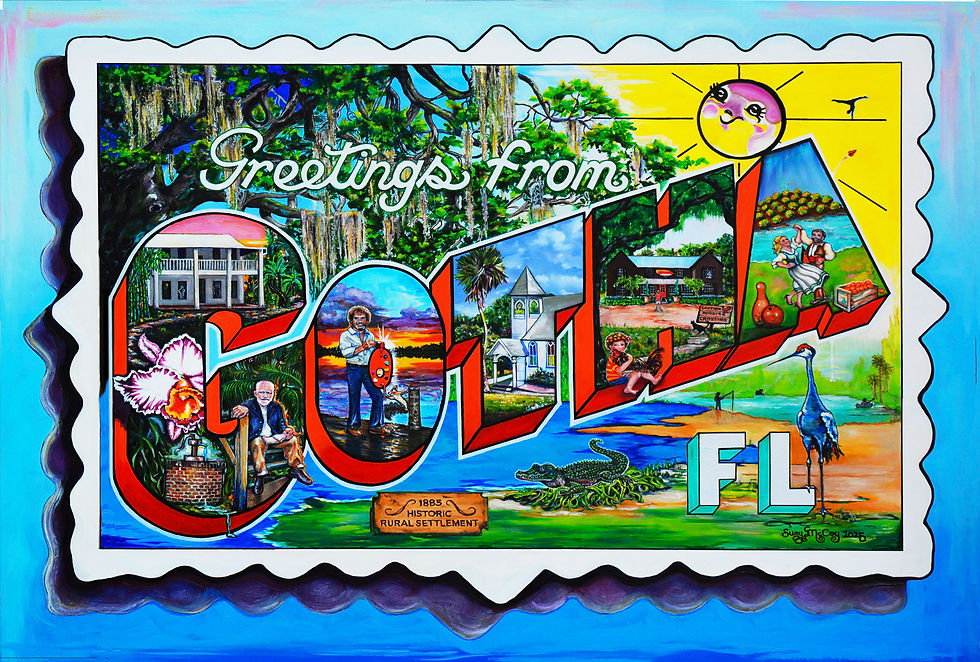
Thank you for stopping by and taking a glimpse into Gotha's history through the eyes of a longtime resident. This postcard-inspired artwork tells a personal story about one of Central Florida's hidden gems and offers a small window into the people, places, and history that make this community special.
For a deeper and thoroughly researched history of Gotha, I highly recommend the wonderful book The New Colony of Gotha by Kathleen Klare.
The postcard captures roughly a century of Gotha's story, from the years before World War I to the present day. It highlights the rich German heritage of Gotha's early settlers, whose influence remains woven into the community today.
My appreciation for Gotha has grown during more than 40 years of living here. The ideas reflected in this artwork come from memories that caught my attention over the years, conversations with neighbors who grew up here, family stories, newspaper articles, unusual structures, old construction sites, and the many things that seem just a little "out of place" and make you wonder about the story behind them.
One of the things we love most about this area is its rolling hills. Our home sits on a ridge connected to a larger ridge system that stretches from the Bok Tower area in Lake Wales all the way to South Georgia. Over the years, I've heard many stories about it. Some call it part of the Iron Mountain Range, while others say the soil and elevation are among the oldest and highest in Florida. Here in the heart of the state, we may be as much as 150 feet above sea level. We hope that's high enough!
I hope you enjoy exploring this artwork and discovering a little more about the history, character, and charm of Gotha.
MEMORIES FROM OUR PAST
When we moved to Gotha in 1982, our front yard held an unexpected treasure: a railroad car once used to carry citrus. It sat quietly on tracks that ran from Minorville, that is now the Westgate Properties of Ocoee, and on toward present-day Isleworth. Over time, the train and tracks disappeared, leaving behind only a trail and an old bridge that became our favorite route for walks across the Florida Turnpike. One day, we even enjoyed a picnic atop that abandoned railroad bridge, captivated by its beauty and mindful of its adventure-filled danger. Eventually, the bridge, too, vanished into memory.
Our lawn in Gotha rests atop nearly a foot of asphalt, a remnant of a World War II Army ordnance depot that once occupied this area. In those early years, we reached our home by a winding dirt road that circled a grassy island. The drive was magical, curving around peaceful lakes and beneath canopies of magnificent oak trees draped with Spanish moss. Acres of orange groves stretched around us, especially stunning during harvest season when the landscape seemed to glow more orange than green. As grove trucks rounded the curves on their way to Winter Garden's processing plants, oranges would spill onto the roadside. We happily gathered the unexpected gifts, enjoying fresh citrus straight from the groves.
We were fascinated by the mysterious Quonset huts and scattered concrete foundations dotting the neighborhood. Our mailing address back then was Winter Garden. Some time later residents were given the opportunity to vote and our address officially became Gotha.
Life here has always offered unique surprises. At night, we can hear Disney's fireworks and see their colorful glow in the distance. On holiday evenings from our rooftop, as many as seven different fireworks displays can light the horizon. Our neighbors work throughout Central Florida, from Orlando to Disney and Universal, while enjoying the convenience of nearby Veterans Memorial Highway Interchange.
The area is rich with curious reminders of the past. Pieces of attractions like Splendid China and the Holy Land Experience can still be found scattered about, making for a fun and memorable driving tour whenever family and friends visit. Not far away are fields where buffalo graze, and over the years we've enjoyed encounters with visiting camels, elephants, and ponies, riding them when we could. Closer to home, we keep a respectful eye on the alligators, bears, raccoons, and sandhill cranes that share our neighborhood. Watching their young appear each year is one of life's small joys.
We especially miss hearing the bell tower chimes from Camp Ithiel on Hempel Avenue. Their melodies carried echoes of school days, church gatherings, and simpler times. While we miss those familiar sounds, the quiet that has replaced them has its own charm.
Change arrived in dramatic ways. The Florida Turnpike eventually divided our lake into two. The orange groves were burned, and for days afterward the air was filled with a heavenly aroma, like orange cakes baking in an oven. Sadly, those changes were followed by the rapid development and traffic that transformed much of the landscape we once knew.
To the west, we often witnessed sights that today seem almost unbelievable. Hot air balloons occasionally drifted low enough to touch our lake. Small aircraft landed nearby, and ultralights buzzed overhead with the distinctive sound of flying lawnmowers. Quiet blimps, daring skywriters and open air biplanes pulling banners kept eyes looking skyward to see the midday advertising of local attractions. I once flew from Maguire Airport in downtown Orlando to another Maguire Airport in Windermere. Today, Plantation Grove Shopping Center on McGuire Road occupies what was once that old dirt landing strip. Yet even now, new wonders await. We often step outside to watch rocket launches rising in the eastern sky, and the occasional sonic boom rattling our windows feels like an exciting bonus.
When I think back to shopping at The Gotha Store in the 1980s, I remember gazing across the street at the little white church on Hempel Avenue and wondering about the people who called this town home long before we arrived from up north. Today, Yellow Dog Eats occupies the old store, preserving much of the same layout as the grocery store I once visited. Standing there, looking out those familiar windows, I still find myself imagining the stories, the history, and the artwork that could be inspired by these enduring landmarks.
Gotha has changed in countless ways since we first arrived, but its spirit remains. The roads, lakes, old buildings, and cherished memories continue to connect us to the remarkable place we have been fortunate to call home for more than four decades.
A CLOSER LOOK
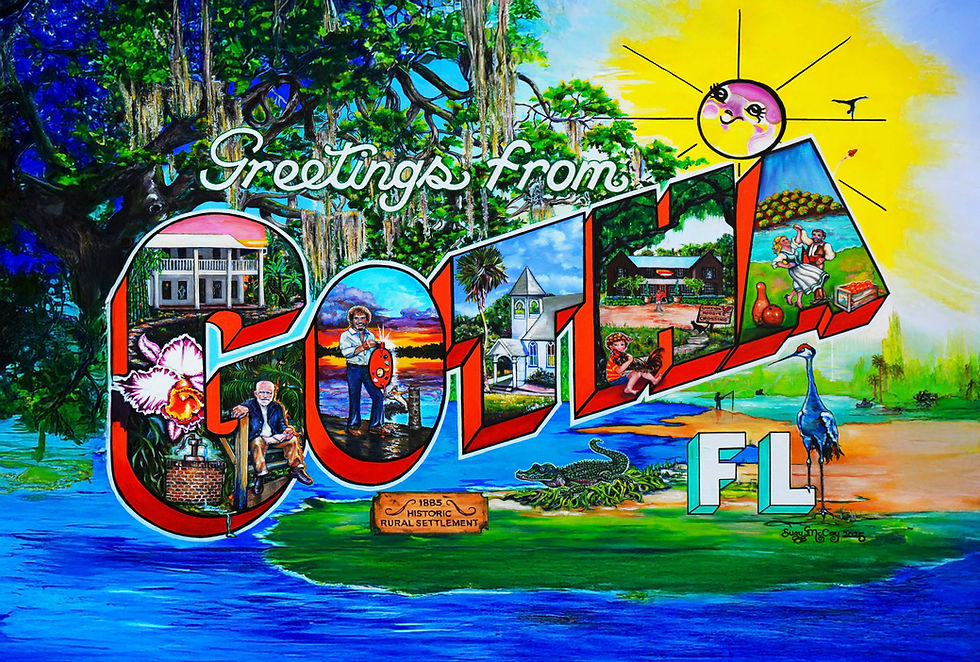
Background Art
.jpg)
LEFT TO RIGHT
-
The old Spanish moss filled oak tree on the northeast corner of Hemple and Gotha Road
-
The acrobat is from the history of gymnastics in Gotha, from the Turner Movement brought from Germany in 1885, putting Gotha on the map as a great cultural center in the US
-
Shown near the fisherman is a tiny black bear, a great blue heron bird, and an alligator that are local creatures
-
My neighbors, Francis Hamm Rhodes, her husband Gary and son Mark are noticeable as a fisherman, a boater and the spirited image in the Yellow Dog Eats window
-
Today folks gather to enjoy watching frequent space launches from our backyards
NEHRLING GARDENS
SUNRISE
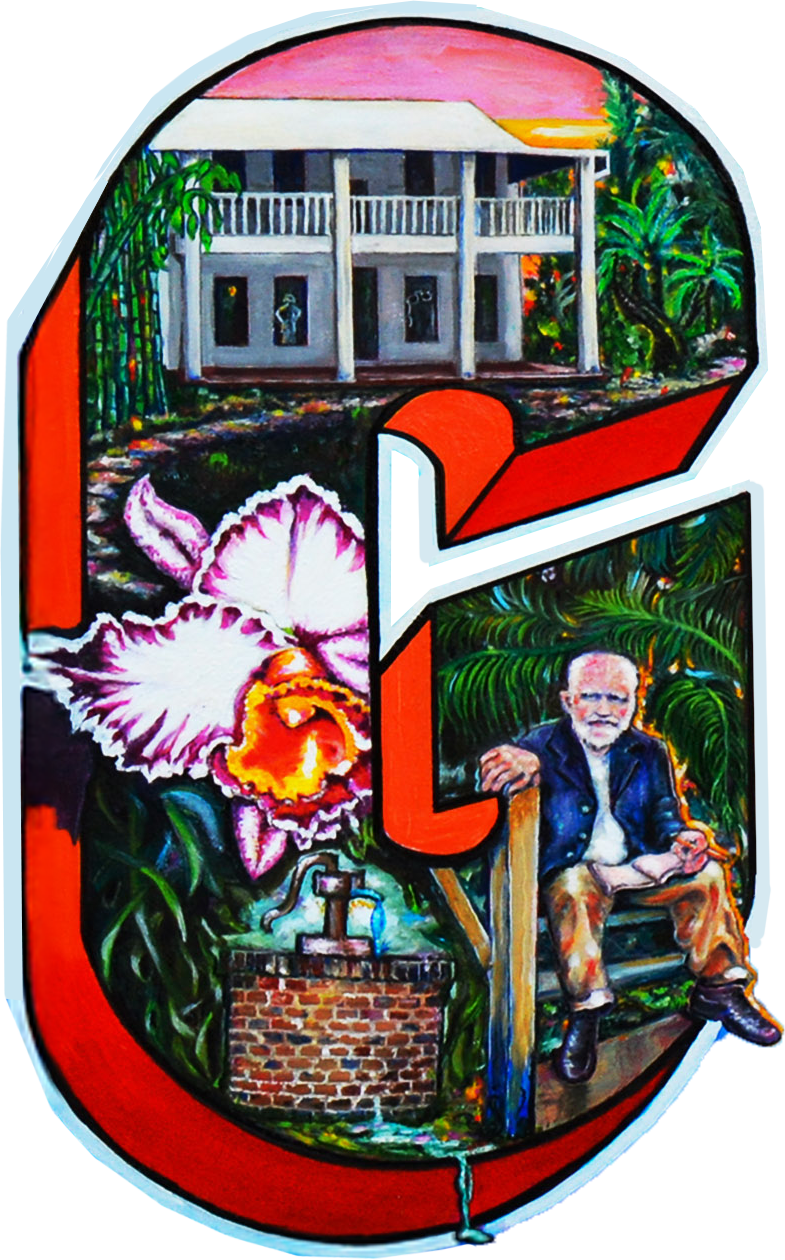
The white two story house sitting onsite in Nehrling Gardens is the Palm Cottage. It is listed on the National Register of Historic Sites. Forefront in the letter G is renowned botanist, horticulturist, and ornithologist, Dr. Henry Nehrling, known as the patron saint of Florida gardens. He is resting with his book of scientific writings that he documented from 1853-1929.
Figures in the windows of the cottage are imagined depictions of spirits of several famous visitors at Nehrling Gardens. Thomas Edison’s light bulbs needed filament material from Nehrling’s varied plants selection. Henry Ford was interested in experimenting with rubber for his car tires from Nehrling’s live plants. President Theodore Roosevelt, represented by his pince-nez glasses, was interested in Dr. Nehrling’s groundbreaking scientific work and teachings.
Illustrated flora include bamboo, sago palms, and an orchid that is waiting to adorn a lucky neighbor’s lapel on their way to church. The well has a drip from the hand pump, and the brick structure leaks at the bottom and flows into Lake Nally located behind the gardens. The multicolored pathway and botanical scene represent the thousands of species of plant life Nehrling collected from around the world.
My husband modeled as Dr. Nehrling onsite at the gardens and at home on our stairs.
Woodlawn Memorial Gardens
SUNSET SCENE
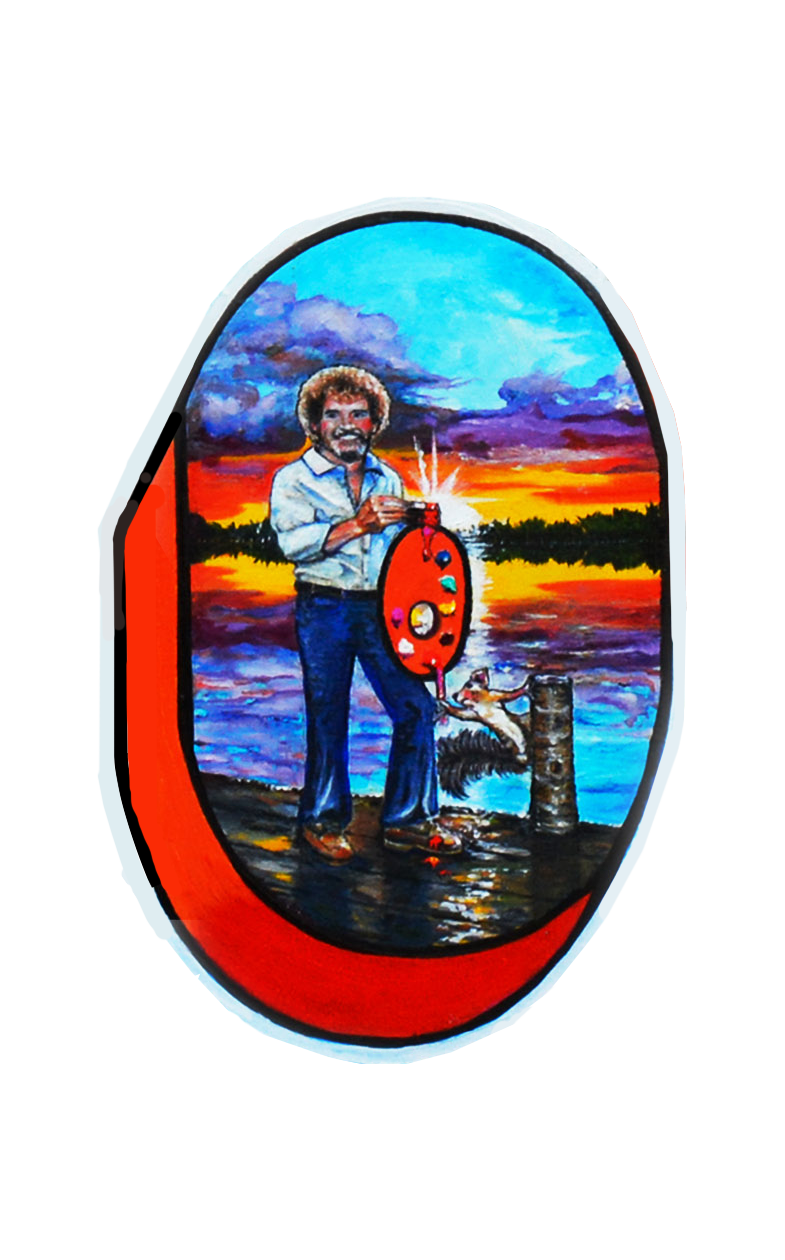
Woodlawn Memorial Gardens is the 65 acre resting place of Dr. Henry Nehrling. The beloved TV artist Bob Ross and many other talented Gotha folks rest here. Woodlawn is Gotha’s second officially designated cemetery, established in 1926.
This beautiful landmark boasts a magnificent mosaic imported from Italy depicting "The Last Supper". There are many natural vignettes to admire in quiet thought including a labyrinth and meticulously groomed gardens and statuary displayed exhibiting perfect craftsmanship. One wants to stay there forever.
A local icon, Bob Ross is imagined to be searching for the perfect sunset to paint from a dock. He holds a paintbrush dripping red paint onto his shoe and the ferrule is gleaming in the sunshine. His paint pallet is the O’s center. An animal lover, he sometimes kept an adoring squirrel in his pocket. Depicted here, it reaches for Bob’s kind attention and enjoys playing in the paint drips.
More modeling work here for my husband. He wrestled with the magical paint pallet and posed in our backyard on an imaginary mundane rickety dock with just the right lighting. The breathtaking sunsets are real and fill my camera storage.
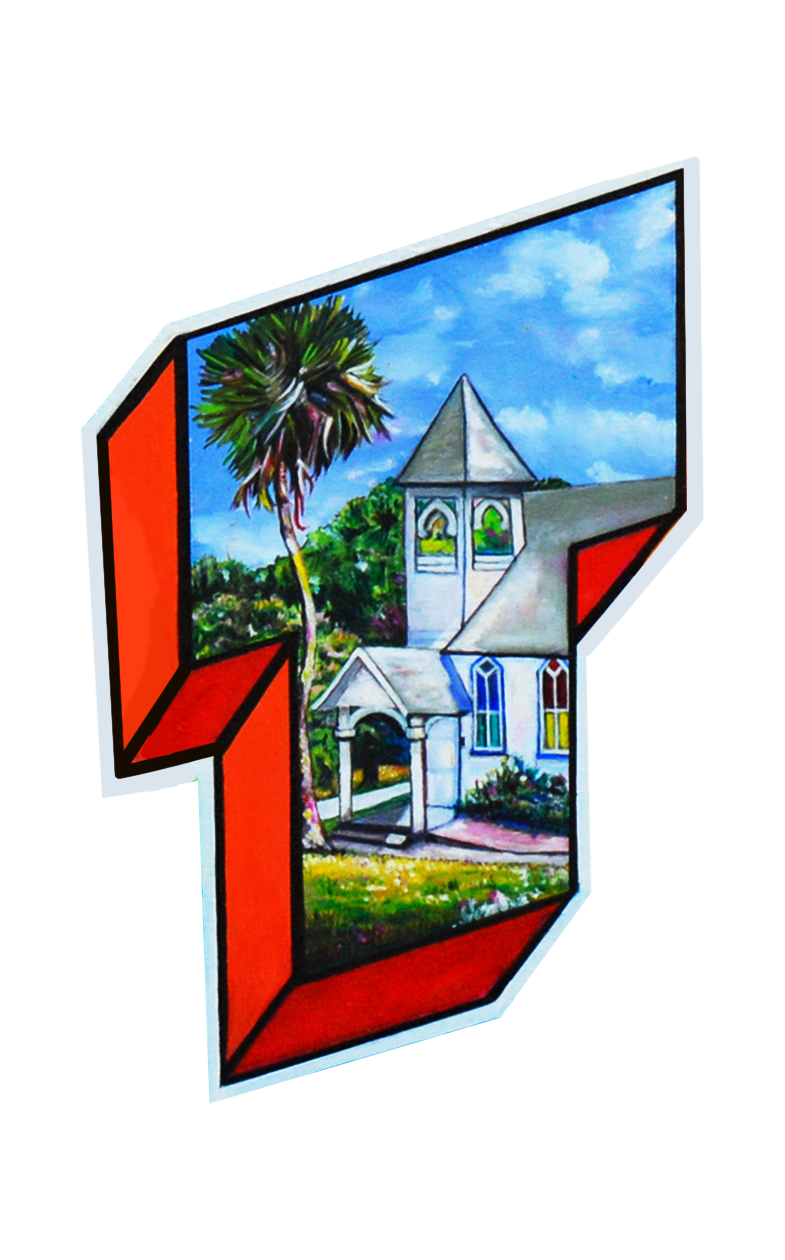
Zion Lutheran Church
MIDDAY SUNSHINE
Zion Lutheran Church holds original pews hand carved by early German craftsmen and laborers who relocated to Gotha after WWII. Gotha was named to honor their German home. The church is the centerpiece of the town, located at the southeast corner of Hemple Avenue and Gotha Road.
Dr. Nehrling’s parents were from Erfert, Germany. Sometimes the church was made up of only German speaking parishioners. Dr. Nehrling would stand in as organ player and Sunday school teacher when necessary. Many community picnics were enjoyed on the church grounds along with holiday celebrations.
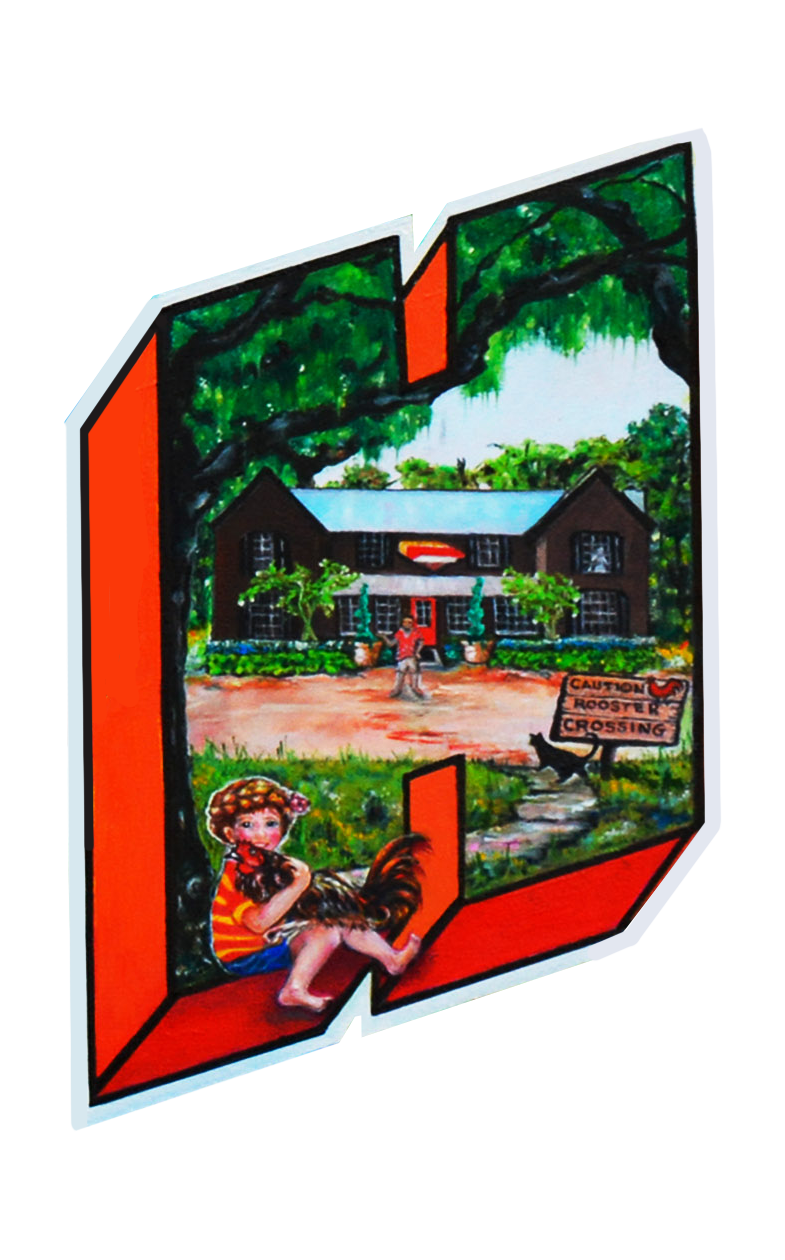
Brockman House
Yellow Dog Eats
AFTERNOON RAIN PASSES
Yellow Dog Eats, originally called the Brockman House, is casual dining in a vintage 1910's brown two-story building. Renowned award winning chef and owner of Yellow Dog Eats, Fish Morgan, is depicted at the entrance. He created this iconic place, well worth a drive for a memorable visit and a consistent stupendous meal. Eat indoors or out. Located at 1236 Hempel Ave, Gotha, FL.
Watch for occasional chicken parades at the 3-way stop. You never know what those chickens will do, or if they will even show up. A more dependable black cat roams the compound. Bring your own dog
Upstairs in the building window is a spirited nod to Frannie Hamm and the Hamm family. They were an original Gotha family that ran the old Gotha Store for many years, occupying the building for the longest stretch of time.
My artist daughter, Samantha, depicted in her childhood years, is shown guarding a chicken across the street under one of Gotha’s beautiful 200 year old moss filled Florida Live Oaks.
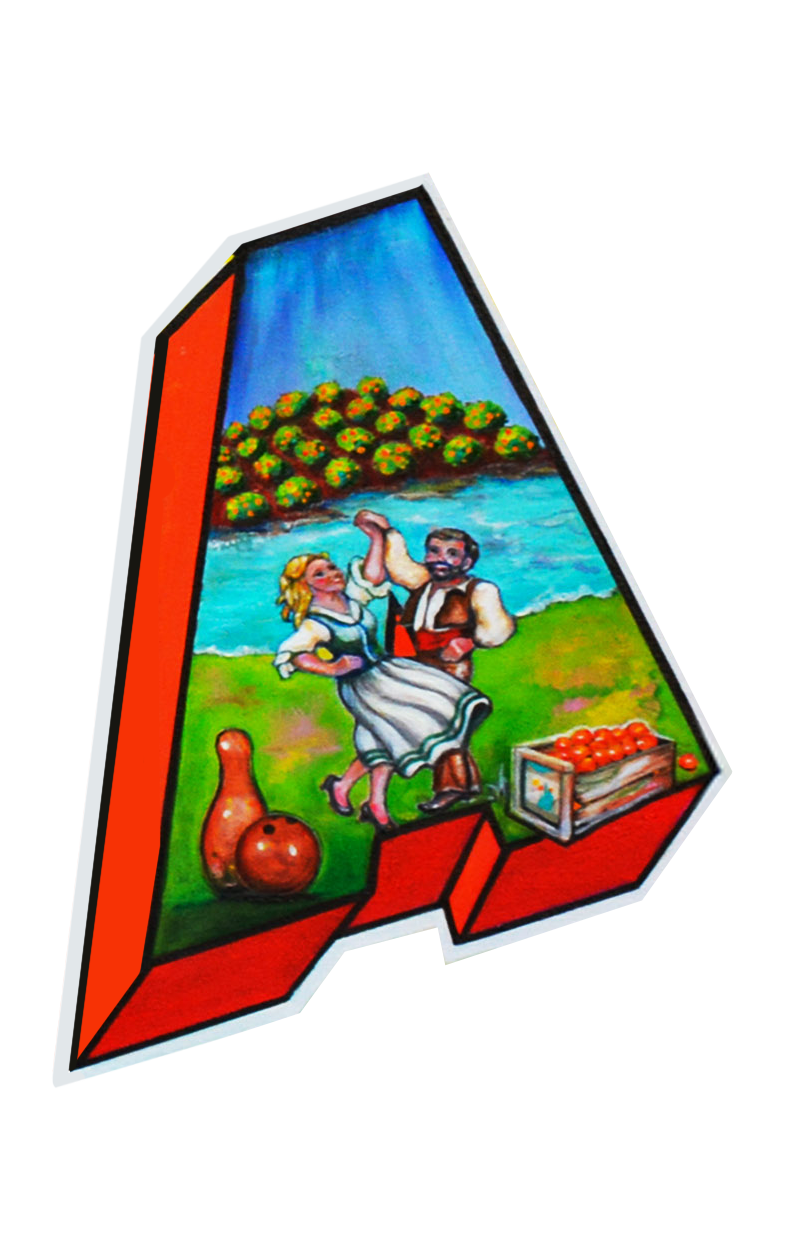
Early German residents
BEFORE THE RAINSTORM
Early German residents of Gotha labored long and hard in the sweltering Florida heat while always remembering and maintaining their cultural heritage from Europe. They enjoyed folk dancing, gymnastics, bowling, movies, innovative childcare, education, and fellowship gatherings. Depicted, too, is their care in the development of the citrus industry, grove care, lumbering, crate building, citrus distribution, and enjoying a hard and happy community life.
Artist Suzy and Sam McCoy are depicted as the folk dancers.
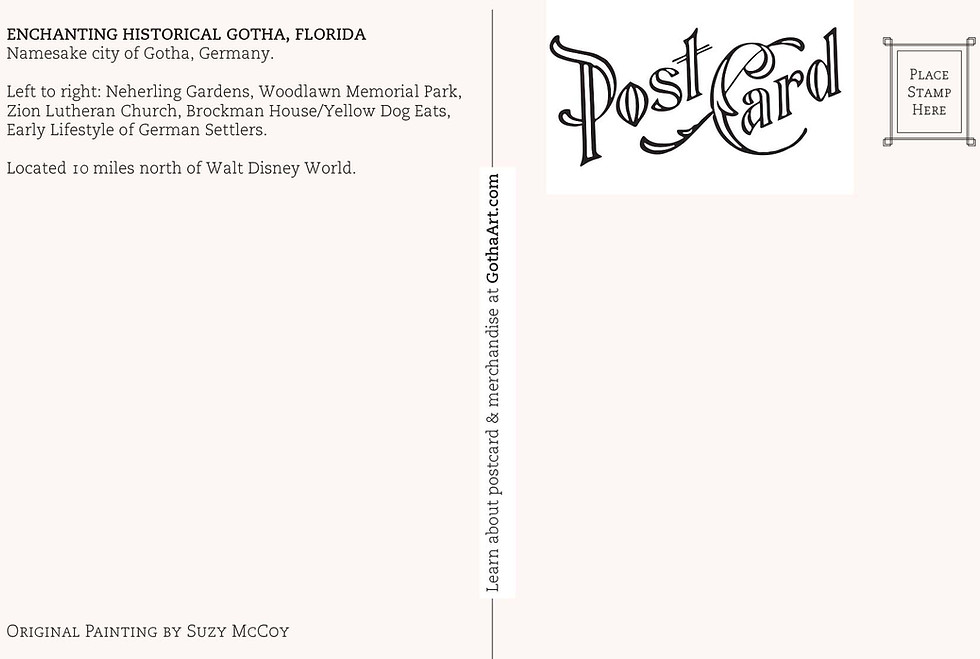
CREATION PROCESS
The creation of this postcard was a true labor of love, one that took years of research, discovery, and careful attention to detail. I began developing the Gotha postcard during the early days of COVID. What started as an idea during that uncertain time gradually grew into a five-year journey before the postcard finally went to print.
I have always enjoyed collecting postcards when I travel. Yet no matter where I looked, I could never find one that captured Gotha. I imagined a postcard that would tell visitors that Theodore Roosevelt, Thomas Edison, and Henry Ford once walked these very streets. During their visits to renowned botanist Dr. Henry Nehrling, Gotha was a remarkable cultural destination. Many of these influential figures later established homes in Fort Myers, where they continued their friendships and their world-changing work. Their homes there are well worth a visit, too.
Along the way, small clues led me to forgotten stories and fascinating glimpses into a way of life that is slowly fading from view. I also witnessed the tremendous dedication of local residents who have worked tirelessly to preserve Gotha's remaining treasures. The town's founders, who arrived from Germany and named their new home after Gotha, Germany, could never have imagined the community we know today. Yet they loved this land and chose to make it their home, just as many of us have.
My goal was to tell Gotha's story in a way that was visually appealing, historically meaningful, and concise enough to fit within the tiny space of a postcard. To accomplish that, I created hundreds of sketches and assembled countless photographic collages, searching for the right balance. I carefully researched native wildlife, historic buildings, local plant species, and accurate likenesses of the people who once shaped this community. Gotha's rich history deserves to be celebrated and shared.
This project quickly became a family effort. My family generously contributed many hours of their time and talents, forming an outstanding support team with their skills in mathematics, technology, and art. The three of us even served as models for sketches and photographs. Along the way, they became my trusted advisors, thoughtful critics, and enthusiastic cheerleaders.
Many friends followed the postcard's progress through its many versions, always eager to know when it would finally be finished. Their encouragement, thoughtful suggestions, and words of wisdom helped shape the final design. I am deeply grateful for everyone who contributed to bringing this project to life.
As you explore the postcard, take a moment to enjoy the tiny details woven throughout the artwork. Each one was carefully chosen to help tell Gotha's story.
Look Closer and You'll Discover:
-
4 important "historical spirits"
-
3 artists
-
1 world-famous botanist
-
1 engineer
-
1 award-winning chef
-
6 native Florida creatures
-
1 gymnast
-
1 space launch
-
8 tropical plants
-
1 sun inspired by a smiling-face orchid
ABOUT THE ARTIST

Suzy Lashlee McCoy is an accomplished commercial artist and sign painter with extensive experience in fine art, mural work, and hand‑lettered commercial signage. Working primarily in Florida and Tennessee, her career spans several decades and bridges traditional craftsmanship with imaginative visual storytelling.
Her fine art has been exhibited at respected venues including galleries in Greenwich Village, New York; Vanderbilt University in Nashville, Tennessee; and the Thomasville Center for the Arts in Thomasville, Georgia. Her work is held in private collections across the United States and Canada.
McCoy’s artistic focus includes painting people, animals, and whimsical subjects—particularly ice cream—using oils, acrylics, and watercolors. Her work is known for vibrant color palettes, playful compositions, and expressive lettering.
Curriculum vitae
Selected Projects & Exhibitions
-
Greetings from Gotha, Florida– A five‑year independent project begun during the COVID period, completed as a 3’ x 4’ oil and enamel painting. The work is a historically researched, imaginative tribute to the 19th‑century Gotha German Rural Settlement.
-
Historical Postcard Illustration – A commissioned line‑drawing postcard displayed at the Gotha, Florida Post Office for over three decades.
-
Private Collection – Acrylic painting held in Toronto, Canada.
Professional Experience
Owner & Artist – Suzy’s Signs / Monk’s Calligraphy
McCoy founded and operated Suzy’s Signs and Monk’s Calligraphy, producing custom hand‑lettered signage and illustrated commercial artwork for clients in Florida and Tennessee.
Entertainment & Creative Services
-
Six years with Walt Disney World, including work at the Living Seas VIP Lounge and contributions to Creative Art Departments
-
Contract work for Universal Studios Orlando
Teaching & International Experience
-
Art instructor in Tennessee and Paris, France
-
Studied art and language in France for one year.
Mural & Public Art
-
DuPont Company History Mural – New Johnsonville, Tennessee
-
Skyway Lanes Historical Mural – New Johnsonville, Tennessee
-
“Unvacant Lot” Downtown Mural – Thomasville, Georgia (assisted), led by Sam McCoy, MFA.
Commercial Clients
Notable clients include DuPont Company, Inland Container Corporation, Consolidated Aluminum Corporation, Pepsi Cola, Loretta Lynn Museum, The Western Trail Riders Association, West Orange 5 Movie Theater, Morris Supply Company, Andrew Johnson Landmark Restaurant, and Ultra‑Hair Salon.
Education & Training
-
Bachelor of Science, Commercial Art – Austin Peay State University, Clarksville, Tennessee
-
Margaret Fort Trahern Art Scholarship Recipient
-
Minors in Health Education and History
-
Apprenticeships and mentorships under established muralists, sculptors, and master sign painters
Additional Background
Originally from New Johnsonville, Tennessee, McCoy has a diverse personal and professional background that informs her creative work. Her experiences include aviation training, skydiving, dance, theater, and music. She is also a licensed Florida real estate broker with over forty years of experience.
Acknowledgements
ADDITIONAL & ACCURATE HISTORY OF GOTHA:
THE NEW COLONY OF GOTHA by Kathleen Klare has an amazing amount of researched history & photographs, a definitive source of knowledge published in 2023, her 10-year labor of love & dedication.
A SINCERE THANK YOU TO KATHLEEN & ALL MY FAMILY, NEIGHBORS & FRIENDS FOR TEACHING ME ABOUT THE GROUND THAT I ENJOY WALKING ON EVERY DAY!
*Yellow Dog Eats & Nehrling Gardens sell THE NEW COLONY OF GOTHA book.
With Special Thanks
This postcard became possible through the encouragement, knowledge, creativity, and support of many wonderful people. Every conversation, shared memory, suggestion, and act of kindness helped bring Gotha's story to life. My heartfelt gratitude goes especially to:
Sam McCoy – engineer, technical advisor, and problem solver
Samantha McCoy – fine artist, creative collaborator, and inspiration
Christopher Rivera – fine artist
Robert Meyers – fine artist
Gretchen Turner – fine artist
The enduring spirits of Thomas Edison, Henry Ford, Theodore Roosevelt, and Francis Hamm Rhodes, whose stories continue to enrich Gotha's history and imagination
Chef Fish Morgan and the Yellow Dog Eats team – creators of one of Orlando's most beloved dining destinations
The Nehrling Gardens Staff – dedicated stewards of a remarkable living legacy
Woodlawn Memorial Gardens – home to beautiful tile mosaics and the final resting places of Dr. Henry Nehrling and artist Bob Ross
Zion Lutheran Church – an enduring cornerstone of the Gotha community
The Rhodes Family: Gary, Frannie, and Mark – preserving memories of fishermen, boaters, and the spirited history of the lake
The Hombree Family – for portrait inspiration and shared community stories
Dr. Gloria Rotan – for the inspiring Gotha billboard idea
The Brigmond Family – generous keepers of local history
Beth Thomas and her artistic family – for encouragement and creative insight
Edwin Downing – steadfast supporter
Jean Hansen – valued supporter and friend
Jean Hurst – former Gotha Postmaster and a treasured link to Gotha's past
Order Postcards
We are currently only accepting orders via email. We accept payment with check, cash, or PayPal. Please fill out the form below and include the quantity, desired payment method, and a brief message.
Postcard $4.50 each (free shipping)
Bulk order pricing available upon request.